The LANTITE is the Literacy and Numeracy Test for Initial Teacher Education: two separate two-hour computer tests, literacy and numeracy, 65 questions each, run by ACER in four windows a year. Every student in an accredited Australian teaching degree has to meet the standard in both before they can graduate, and the standard is personal literacy and numeracy in the top 30 per cent of the adult population. In 2025, 87.5 per cent of first-time candidates met the literacy standard at their first attempt and 94.3 per cent met numeracy. This page answers the questions people actually ask about it, with ACER's own rules as the source.
What is the LANTITE test?
It is a national test of your own literacy and numeracy, not of how you teach them. The requirement that teaching graduates demonstrate skills in the top 30 per cent of the adult population dates from 2011, and the test that measures it has run since 2016, developed and administered by the Australian Council for Educational Research (ACER) on behalf of the Australian Government. It is separate from any literacy or numeracy assessment your university runs, and passing those does not exempt you.
You have to sit it if you are enrolled in an accredited initial teacher education course, undergraduate or postgraduate. Students who started their course from 2024 onwards are expected to attempt it in their first year (not necessarily pass it then), and some states and territories require you to have met the standard before your final placement or before teacher registration. Prospective students who are not yet enrolled can also sit it. A small number of candidates meet an accepted alternative standard set by AITSL instead; your provider can tell you whether that applies to you.
Sources: ACER, eligibility and the Department of Education.
How many questions are on the LANTITE?
Literacy: 65 questions, one section
- About two-thirds are reading questions on procedural, regulatory and technical texts; descriptive, informative and persuasive texts; and narrative texts.
- Reading is assessed as three processes: access and identify, integrate and interpret, evaluate and reflect.
- About one-third are technical skills of writing: syntax and grammar, spelling, word usage, text organisation.
- Selected-response (multiple choice) and short-answer questions; no essay.
Numeracy: 65 questions, two sections
- Section 1: 52 questions with a basic on-screen calculator. ACER suggests 90 to 95 minutes.
- Section 2: 13 questions with no calculator. ACER suggests 25 to 30 minutes.
- Three content areas: number and algebra, measurement and geometry, statistics and probability.
- Most questions apply maths to a real situation rather than testing a bare procedure.
Every literacy question and most numeracy questions are set in one of three contexts: personal and community life, schools and teaching, and further education and professional learning. That is why a numeracy question is more likely to be about a class excursion budget or a growth chart than a bare equation. Source: ACER, test content and assessment framework.
How long is the LANTITE test?
Two hours for each component, and that includes a short tutorial at the start, so the working time is a little under 120 minutes for 65 questions: under two minutes a question. Literacy and numeracy are separate sittings. You can book them as consecutive sessions on the same day, on different days, or in different windows altogether. At a test centre, check-in takes about 30 minutes before each component; for a remotely proctored sitting the pre-test checks take 30 minutes to an hour. You can leave once you have finished, but not during the last ten minutes of a component.
Can you use a calculator in the LANTITE?
Not your own: personal calculators are on ACER's list of banned items, along with phones, smart watches, rulers and note paper. In the numeracy test, section 1 (52 questions) gives you a basic on-screen calculator; section 2 (13 questions) does not. The order is fixed, and once you start section 2 you cannot go back to section 1, so ACER's advice is not to rush the first section. The same on-screen calculator is built into ACER's practice questions in your candidate account, and it is worth using it there first, because it does not behave like the one on your phone. Our practice exams run the same split, with a calculator in section 1 only.
Is the LANTITE hard?
The content is upper high-school level: percentages, ratio, area and volume, reading graphs, grammar and spelling. What makes it hard is the standard and the clock. The standard is the top 30 per cent of the adult population, so it is not a formality, and 65 questions in under two hours leaves no time to work anything out from first principles.
The Department of Education publishes the numbers. In 2025, 87.5 per cent of first-time candidates met the literacy standard at their first attempt and 94.3 per cent met the numeracy standard, so about one in eight misses literacy first go and one in seventeen misses numeracy. Most of those meet it soon after: of the students who registered in 2022, roughly 98 per cent had met each standard by their fourth year. The full tables, and what the statement of results looks like, are on our LANTITE results page.
What is the LANTITE pass mark?
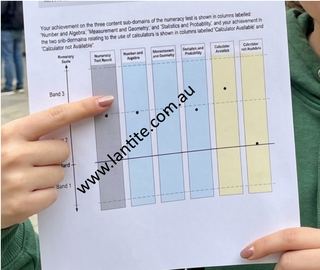
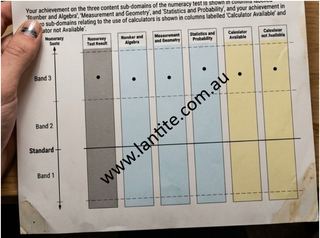
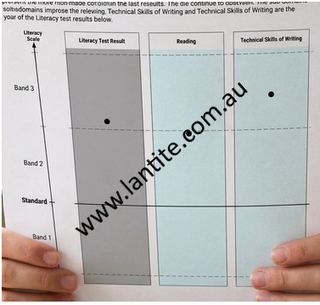
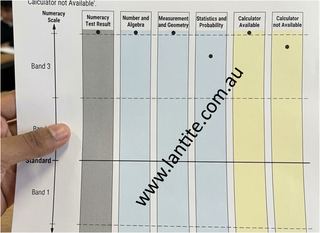
There isn't one, and ACER says so: the questions change every sitting, so the number you need correct changes too, and it will not give a number of questions or a percentage. Each sitting is scaled to the same fixed standard and you are told whether you met it, with your result plotted in three proficiency bands for each sub-domain. The practical advice is to prepare to be comfortably over the standard rather than just over it.
Want to practice these questions yourself?
Our app has thousands of LANTITE-style questions with step-by-step solutions and AI tutoring, plus 69 video lessons and ten full-length practice exam papers.
Get Started Free →How many times can you sit the LANTITE?
As many times as you need. Following the National Teacher Workforce Action Plan trial, education ministers removed the attempt limit from 2025 (the old rule was three attempts, and some university pages still say so). You only resit the component you did not meet, a met component never expires, and your results transfer if you change university. Each attempt is a new registration and a new fee. If you have just missed, read what happens after a failed LANTITE.
How much does the LANTITE cost?
$196 for both components or $98 for one, GST inclusive, paid to ACER when you register and payable again for every attempt. There is no discount for booking both together, refunds stop when registrations close, and only three universities cover the fee for eligible students. Details, refund deadlines and who pays are in the LANTITE cost guide.
Where do you sit the LANTITE?
At a test centre
Supervised centres in the capital cities and some regional areas. Bring photo ID that matches your registration exactly and your admission ticket; you are given a pen and scratch paper one sheet at a time. Bags, phones and watches with alarms stay away from the desk.
At home by remote proctoring
A live proctor watches through your webcam in ACER's locked-down Guardian browser. You need a clear desk, two sheets of blank paper, a reliable connection, and a room to yourself. Remote sittings finish five days before each window closes. Setup and the usual failure points are in our Guardian browser guide.
Source: ACER, permitted testing aids.
When is the LANTITE?
Four windows a year, each about two weeks long, with registration opening five weeks before a window and closing three weeks before it. The last 2026 window runs 26 October to 8 November, with registration 22 September to 5 October; 2027 opens with a window on 15 to 28 February, registration 12 to 25 January. Every date, including when results come out, is on the LANTITE test dates 2026 page, along with the step-by-step registration guide.
How do you prepare for the LANTITE?
Start with ACER's own practice questions in your candidate account; the set is small, but it is the official format and it has the real on-screen calculator. Then practise in the format under time, because the test rewards pace and familiarity more than knowledge: work through free practice questions to find your weak areas, follow the 8-week study plan, and sit at least one full-length practice exam under a real clock before test day. The app behind this site has thousands of questions with worked solutions, 69 video lessons and ten timed papers, and the video lessons and the first paper are free.